Can You Drink Alcohol While Taking Ambien?
Quick answer: No. Alcohol and Ambien (zolpidem) should not be combined. Both slow down the central nervous system, and together they can cause extreme drowsiness, confusion, slowed or stopped breathing, blackouts, and dangerous complex sleep behaviors such as sleepwalking and sleep-driving. The prescribing information and Medication Guide advise against drinking alcohol while taking the medicine, and there is no officially established “safe” gap between the two.
Most people do not mix them on purpose. It happens at a dinner party when you have already taken your tablet early “to get ahead of it,” on a night when you take Ambien after a few drinks because you cannot switch off, or when you simply forgot it was in your system. This guide is built around those real-life moments. Instead of a general lecture, it walks through eight common “what if” scenarios and then explains the science behind the answers, so you can make a safer decision in the moment.
In this guide: Why the mix is risky · Eight “what if” scenarios · Hidden alcohol · What about timing? · Does alcohol help you sleep? · If you drink regularly · Emergency signs · Myths vs facts · Better alternatives · FAQs
Why alcohol and Ambien are a risky pair
Two sedatives, one brain
Alcohol and zolpidem both act on the brain’s GABA system, the main “calming” signal, though they do it in different ways. Zolpidem boosts GABA’s effect at a specific receptor type, and alcohol also enhances GABA signaling while dampening excitatory signals. Together, the effects add up and can be stronger than either alone. If you want the full background on how zolpidem works, see our guide to Ambien uses and how it works.
The combined effects
- Deeper sedation and confusion. You may be much harder to wake, or behave in ways you do not recall.
- Slowed breathing (respiratory depression). This is the most dangerous effect, and the risk rises if you have sleep apnea, a lung condition, or heavy alcohol intake.
- Memory blackouts. Both substances can impair memory formation, so combined use makes gaps in memory more likely.
- Complex sleep behaviors. The FDA boxed warning for zolpidem covers sleepwalking, sleep-driving, and other activities while not fully awake. The labeling notes these behaviors can occur with zolpidem alone, and that alcohol and other sedating substances increase the risk.
- Impaired coordination and judgment, which raise the risk of falls, injuries, and accidents, including next-day driving problems.
- Lower blood pressure and dizziness, making night-time falls more likely.
The key point: the effects are unpredictable
Two people can take the same dose and the same drink and react very differently. Body size, sex, age, liver function, tolerance, other medicines, and even how recently you ate all change the outcome. Women generally clear zolpidem more slowly, which is why labeling recommends a lower starting dose. Because there is no way to predict your personal response in advance, the safest approach is not to combine them. The full list of reactions is in our guide to Ambien side effects.
Eight “what if” scenarios
Scenario 1: “What if I have just one drink with dinner and take Ambien at bedtime?”
There is no officially established safe interval, and the guidance remains to avoid alcohol while taking Ambien. A single drink is less risky than several, but “less” is not “none,” and individual responses vary. Zolpidem is taken immediately before bed, which means any alcohol still in your system when you take it is overlapping with the drug. If you are on Ambien, the safest plan is to skip alcohol on nights you plan to take it. If you want to drink, speak to your prescriber about whether to skip the pill that night instead. Do not decide that for yourself by guessing a time gap.
Scenario 2: “What if I already took my Ambien and then someone hands me a drink?”
Say no. Zolpidem starts working within roughly half an hour, so once you have taken it, you should be heading to bed, not socializing. If you are at an event, put your phone alarm on, stay away from alcohol, and go home or to bed soon. Do not drive. If you are away from home, arrange a ride or a safe place to sleep.
Scenario 3: “What if I had several drinks and cannot sleep? Can I take my Ambien to settle down?”
This is one of the highest-risk situations. Heavy drinking plus a sedative-hypnotic carries a real danger of suppressed breathing and blackout behavior. Alcohol can also make you restless and wake you in the second half of the night, so using Ambien to counter it is tempting, but it is not safe. Do not take it. Drink water, eat something if you can, lie on your side, and ask someone to check on you. If you feel confused, very sleepy, sick, or if your breathing seems unusual, treat it as an emergency (see emergency signs).
Scenario 4: “What if I took Ambien and woke up to find I had been drinking, but I do not remember?”
This is a classic sign of a complex sleep behavior, an episode of doing things while not fully awake, which the boxed warning describes. Stop taking Ambien and contact your doctor, as the label directs. If alcohol was involved, make sure you tell the doctor, since the combination makes episodes more likely. Secure alcohol and car keys, and let the people you live with know what happened. See our guide for bed partners and family.
Scenario 5: “What if I drank last night, and I am taking Ambien tonight?”
Alcohol and zolpidem clear at different speeds, and a hangover is not a reliable gauge of what is left in the body. Prior-night drinking is generally a smaller concern than same-night drinking, but heavy drinking can affect liver function, sleep quality, and next-day alertness, all of which interact with how you handle the medicine. If you drank heavily, you may want to talk to your doctor before taking it again, especially if you have liver problems, because impaired liver function slows zolpidem clearance and the label recommends a lower dose in liver impairment.
Scenario 6: “What if I am only using Ambien occasionally, such as for a flight or a few nights during travel?”
Occasional use does not remove the interaction. Travel can raise the risk further: unfamiliar surroundings, a different time zone, and cabin conditions. Many people drink on flights or in hotel bars to unwind, then take a pill. This is exactly the setup in which sleep-related accidents and next-day impairment occur. Choose either the drink or the pill, and ask your doctor which strategy suits your trip. Take the medicine only when you can get a full night’s sleep.
Scenario 7: “What if I take Ambien CR, the extended-release one?”
The extended-release form stays active longer, and the labeling notes a greater risk of next-morning drowsiness. That makes any alcohol overlap more concerning, including alcohol the evening before or the next morning. The same rule applies: do not combine them, and be careful about driving the following day.
Scenario 8: “What if someone else has taken Ambien and alcohol together?”
Treat it seriously. Try to wake them. If they respond normally, stay with them and monitor their breathing and alertness. Call emergency services if they are very hard to wake, confused, breathing slowly or noisily, turning blue or gray, or vomiting while drowsy. Place them on their side if they are unconscious but breathing. In the United States, Poison Control (1-800-222-1222, or poison.org) can advise. Do not leave them alone to “sleep it off.” Do not give coffee or a cold shower as a treatment, since neither reverses the sedation.
Hidden alcohol: where it turns up unexpectedly
People who avoid cocktails still sometimes take in alcohol without thinking. Check labels and ask your pharmacist about:
- Liquid cold and cough medicines, some of which contain alcohol, particularly night-time formulas, which also often contain sedating antihistamines
- Herbal tinctures and bitters
- Some mouthwashes, which are not meant to be swallowed, but worth noting if there is a risk of ingestion
- Kombucha and other fermented drinks, which can contain small amounts of alcohol
- Desserts and sauces made with wine, rum, or liqueurs
- “Low alcohol” or “alcohol-free” beer and wine, which can contain small amounts, so read the percentage on the label
Night-time cold remedies deserve special attention because they combine sedating antihistamines with alcohol, both of which can add to zolpidem’s effects. Review all products with a pharmacist, and see our guide to Ambien drug interactions for other combinations to avoid.
What about timing? Why there is no magic number
People often ask, “How long should I wait between a drink and my Ambien?” It is a sensible question, but there is no official, universally safe answer, and any article that gives you one is guessing. Here is why.
- Alcohol clearance varies. The body processes alcohol at a fairly steady rate, but that rate depends on your liver, body size, sex, food intake, and what you drank.
- Zolpidem clearance varies too. The typical half-life of immediate-release zolpidem is a few hours, but it is longer in women, older adults, and people with liver impairment, and it is affected by other medicines.
- Effects can outlast the blood levels you can feel. You can feel “fine” while performance is still impaired.
- The risk is not only about breathing. Complex sleep behaviors and blackouts can occur even without dramatic sedation.
The practical takeaway: do not use a timing formula you read online. Ask your own prescriber or pharmacist what they advise for you, and default to no alcohol on the days you take Ambien.
Does alcohol actually help you sleep?
Many people use a nightcap to ease into sleep, and it can make you drowsy at first. But alcohol tends to make sleep worse overall:
- It can reduce REM sleep early in the night, then cause rebound disruption later.
- It fragments sleep and causes early-morning waking as it wears off.
- It relaxes throat muscles, which can worsen snoring and sleep apnea.
- It acts as a diuretic and can send you to the bathroom more often.
- Regular use builds tolerance, so you need more to get the same effect, while sleep quality keeps declining.
Using alcohol and a sleeping pill to try to fix the same problem is a bit like treating a leak by adding more buckets. A better route is to look at why sleep is difficult. The National Institute on Alcohol Abuse and Alcoholism (NIAAA) provides information on alcohol’s effects on health and sleep.
If you drink regularly or heavily and also use Ambien
This situation needs honest conversation with a doctor, and it is nothing to be embarrassed about. Some people find that they drink to sleep and then rely on pills to counter the effects, and the two habits feed each other.
- Tell your prescriber how much you really drink. They can only keep you safe with accurate information. Alcohol intake changes which sleep treatments are suitable.
- Do not stop heavy drinking suddenly on your own. Abrupt cessation after long, heavy use can cause dangerous withdrawal, including seizures. Medical support makes it safer.
- Be cautious about sedatives. A history of alcohol misuse raises the risk of dependence on sedative-hypnotics, which is one reason the label urges caution.
- Treat the sleep problem and the drinking together. CBT-I, treatment for underlying anxiety or depression, and alcohol support services often work better than medicine alone.
- Support is available. In the United States, the SAMHSA National Helpline (1-800-662-4357) offers free, confidential referrals at any hour. See SAMHSA’s helpline page. If you live elsewhere, your doctor or national health service can direct you to local help.
Emergency signs after mixing alcohol and Ambien
Call your local emergency number (for example 911 in the United States, 112 in many other countries) if you or someone else shows any of these signs:
- Cannot be woken, or only briefly rouses
- Very slow, shallow, irregular, or noisy breathing, or pauses in breathing
- Blue, gray, or very pale lips or skin
- Confusion, slurred speech, or inability to stand
- Repeated vomiting while drowsy, or choking
- A very slow heartbeat, fainting, or collapse
- A seizure
- Any accident or injury that occurred during sleep-driving or sleepwalking
Do not wait to see whether it passes, and do not leave the person alone. While waiting for help, keep them on their side with the airway clear.
Myths vs facts
| Myth | Fact |
|---|---|
| “One glass of wine will not matter.” | Effects vary person to person, and the guidance is to avoid alcohol. A single drink is lower risk than several but not risk-free. |
| “If I wait two hours, I am safe.” | There is no established safe interval. Clearance varies widely. |
| “I have a high alcohol tolerance, so it will not affect me.” | Tolerance to alcohol does not protect your breathing or prevent complex sleep behaviors. |
| “Coffee or a cold shower will counteract the sedation.” | They may make you feel more awake, but they do not reverse the drugs’ effects or the breathing risk. |
| “Ambien is just a sleeping pill, so mixing it is like mixing it with melatonin.” | Zolpidem is a prescription sedative-hypnotic and a controlled substance, with a boxed warning. It is a very different category from melatonin. |
| “Alcohol helps me sleep, so Ambien plus a drink helps even more.” | The combination increases risk without improving sleep quality. |
| “The next-day effects will be obvious, so I will know if I am impaired.” | People often cannot judge their own impairment, which is one reason next-day driving warnings exist. |
Better alternatives when you want a drink and need to sleep
- Pick one for the night. If you plan to drink, do not take Ambien that night. Ask your prescriber how to handle sleep on those evenings.
- Build a wind-down routine that does not involve alcohol: a warm shower, light stretching, reading, or calming audio.
- Offer yourself a real alternative drink, such as herbal tea (without sedating herbs unless approved by your doctor), sparkling water with citrus, or an alcohol-free mocktail, with the label checked for alcohol content.
- Keep your sleep and wake times consistent and limit caffeine in the afternoon.
- Consider CBT-I, the first-line treatment for chronic insomnia, which reduces the need for both alcohol and sleeping pills.
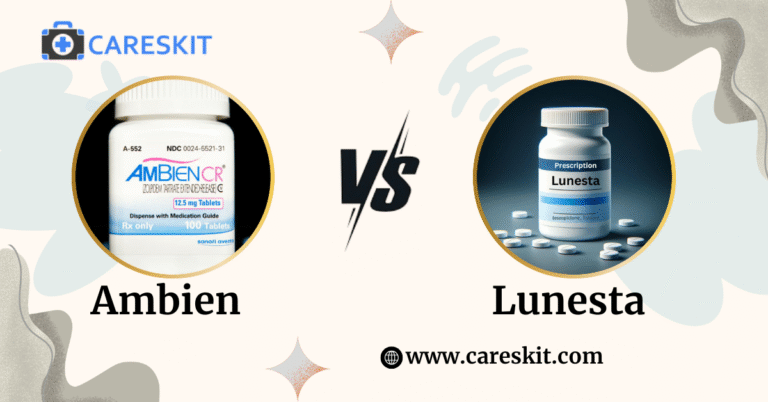
- Ask about other options. Different sleep medicines carry their own alcohol warnings. Compare options in our Ambien vs Lunesta guide and Ambien vs Restoril, then talk with your doctor.
- If you miss or delay a dose, do not make up for it with extra pills or a drink. See what to do after a missed dose of Ambien.
If you are curious about how alcohol interacts with other prescription medicines on this site, you might also read can you drink alcohol while taking Adderall, which covers a very different, stimulant-related risk profile.
Frequently asked questions
Can you drink alcohol while taking Ambien?
It is not recommended. Alcohol and zolpidem both depress the central nervous system, and combining them raises the risk of dangerous sedation, breathing problems, blackouts, and complex sleep behaviors.
How long after drinking can I take Ambien?
There is no officially established safe interval. Because alcohol and zolpidem clear at different rates in different people, ask your doctor or pharmacist for advice specific to you rather than relying on a general number.
What happens if you mix Ambien and alcohol?
You may get stronger drowsiness, confusion, memory gaps, slowed breathing, and a higher chance of sleepwalking, sleep-driving, falls, and accidents. In severe cases, it can lead to unconsciousness, coma, or death.
Is a small amount of alcohol okay with Ambien?
Smaller amounts are less risky than larger ones, but the label advises against drinking alcohol while taking the medicine. The response is unpredictable, so the safest approach is to avoid alcohol on nights you take it.
Can I drink alcohol the day after taking Ambien?
Zolpidem is usually cleared within about a day in healthy adults, but this varies, particularly with liver problems, older age, and the extended-release form. If you have concerns, ask your pharmacist.
Does Ambien increase the effects of alcohol?
Yes. Zolpidem can intensify alcohol’s sedation and impairment, so you may feel more affected than you would from the same drink alone.
Why do I black out when I take Ambien with alcohol?
Both substances impair memory formation. Together, they make memory gaps and unusual actions more likely, which is why complex sleep behaviors are more concerning in this setting.
Is it safe to take Ambien if I only drink on weekends?
Weekend drinking can still overlap with your doses. Plan the nights you take Ambien separately from the nights you drink, and tell your prescriber about your pattern.
What should I do if I accidentally drank alcohol after taking Ambien?
Stop drinking, do not take any more medicine, do not drive, and stay with someone who can check on you. Contact a doctor, pharmacist, or poison center for advice, and call emergency services if you notice breathing difficulty, severe drowsiness, or confusion.
Can I take Ambien if I have a history of alcohol problems?
This needs careful discussion with a doctor. A history of alcohol misuse increases the risk of dependence on sedative-hypnotics, and other treatments may be a better fit.
The bottom line
Alcohol and Ambien are a poor mix. Each slows the brain, together they can slow breathing and trigger memory gaps and unsafe night-time behavior, and no one can predict in advance how a given person will react. The labeling advises against alcohol while using the medicine, and there is no verified “safe waiting time.” On any night you plan to drink, talk to your doctor ahead of time about skipping the pill, and on any night you take it, plan to skip the alcohol. If you ever find yourself in a situation where both have been taken, stay with someone, do not drive, and get medical help at the first sign of trouble.
Medical disclaimer: This article is for general education and is not a substitute for professional medical advice, diagnosis, or treatment. Follow your prescriber’s instructions and the Medication Guide for your product. In an emergency, call your local emergency number.
Sources and further reading: FDA: Ambien prescribing information (check Drugs@FDA for the latest version) · MedlinePlus: Zolpidem · NIAAA · Poison Control · SAMHSA National Helpline